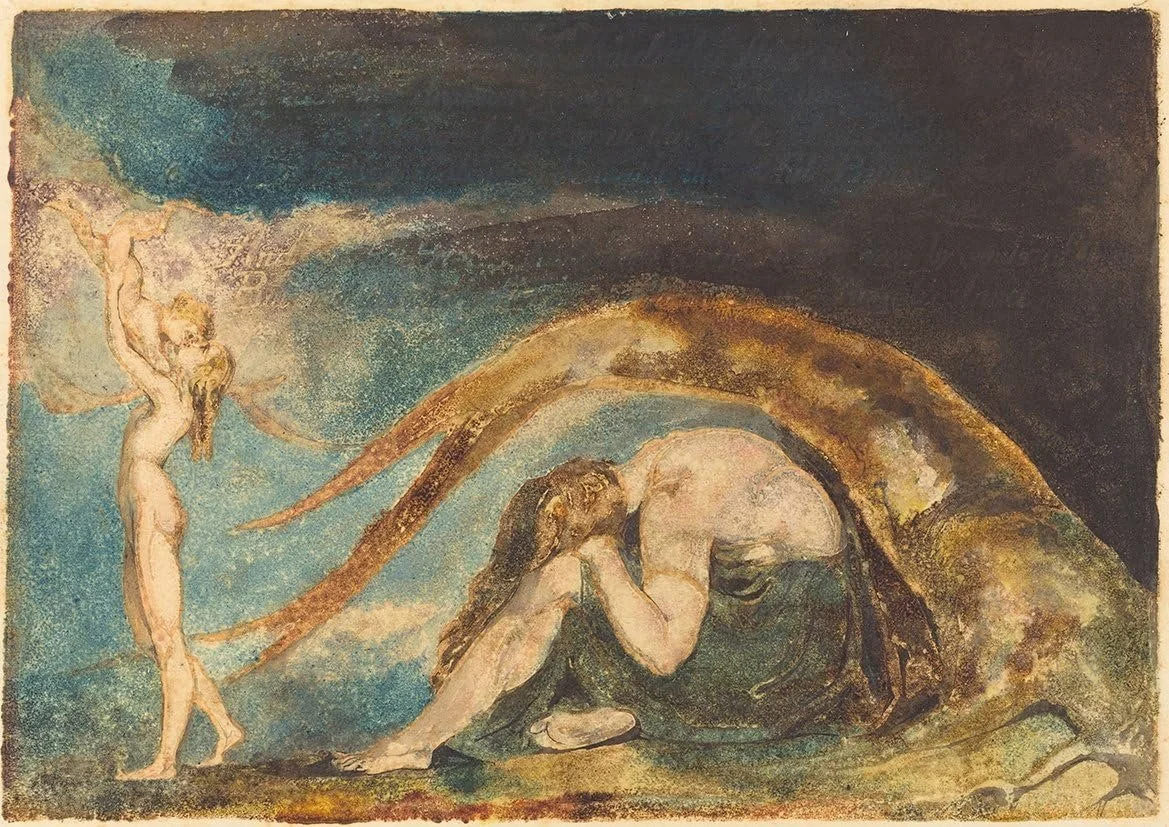
Dream of Thiralatha [from "America," cancelled plate d]. c. 1794/1796 William Blake via National Gallery of Art
In William Blake's late-18th-century work, The Marriage of Heaven and Hell, he mentions "any man of mechanical talents." Blake describes a writer characterized by mental or rational functions used to manipulate symbols and thereby author texts that lack insight and are graceless--that is, unable to receive a boon neither compelled nor owed--such that a text generated by means of those talents may seem more crassly determined than miraculous or gifted.
Although Blake focuses his critique on the writings of Swedenborg specifically, Blake makes a larger point: the mentality or mindset of a writer can be important. Given recent technological advances, consider Blake's text altered to omit the phrase "man of" such that:
"any...mechanical talents may from the writings of Paracelsus or Jacob Behmen produce ten thousand volumes of equal value with Swedenborg’s, and from those of Dante or Shakespeare an infinite number."
And the source text unmodified:
"any man of mechanical talents may from the writings of Paracelsus or Jacob Behmen produce ten thousand volumes of equal value with Swedenborg’s, and from those of Dante or Shakespeare an infinite number."
For Blake, Swedenborg's works exemplify how valuable the output of a mechanical talent or person thereof tends to be such that Blake wrote:
"Swedenborg boasts that what he writes is new; though it is only the contents or index of already published books...Now hear a plain fact: Swedenborg has not written one new truth. Now hear another: he has written all the old falsehoods...Swedenborg’s writings are a recapitulation of all superficial opinions, and an analysis of the more sublime, but no further."
Blake's metaphor for a derivative or synthetic work composed by means of "mechanical talents" is that of a candle in sunshine such that the authors of those derivative works, and those works themselves, contain or transmit knowledge far inferior (and redundant) to that of the solar knowledge of a "master author" who arrives at a text output by means that exceed or transcend the analytical or mechanical.
Ursula K. Le Guin gestures toward a similar kind of distinction in Always Coming Home, which contains the poem Artists; she describes its authorship as "lost" in a low-tech future such that only the poem itself remains known to a group of people who have specialized skills regarding written words (e.g., inkmaking, reading, etc.). The poem characterizes "ordinary artists" as those who use "skill," "intellect," and "delight in tools" such that they deserve praise.
These ordinary artists contrast with "people who call themselves artists" that seek praise and material reward. Furthermore, the poem indicates that ordinary artists and people who call themselves artists are discernible from "mysterious artists," a group whose members are "beyond praise" as per their receptivity, their channel-like openness, their surrender and death-like personal transformation as part of inspiration and its fulfillment or expression in art.

The Circle of the Traitors; Dante's Foot Striking Bocca degli Abbate, 1827 by William Blake via National Gallery of Art
A straightforward mapping between the terminology of Blake and Le Guin: mysterious-solar, ordinary-candelarian. In their passages regarding the mysterious-solar, Blake and Le Guin describe modes of authorship associated with a condition of intellectual humility that permits receipt of a gift or boon that informs or shapes one's writing. Such a gift might fall under the general heading of inspiration (e.g., Le Guin's use of "...where they get their breath...No one else can breathe there").
Blake divinizes (or recognizes the divinity of) such gifts or their receipt as per a sensibility informed by Christian traditions (e.g., learning from angels whether or not they are fallen). Le Guin explicitly distinguishes the Kesh system of the Nine Houses from religion and connects artistic gifts or their receipt with a "center," "hinge," or "gap" associated with concepts of sacredness as per her Taoism-informed sensibility (see: The Serpentine Codex).
Attempting to classify texts or authorships as mysterious-solar or ordinary-candelarian is especially challenging given historical developments that have caused conceptual distinctions between document retrieval or access and document generation to blur. Such blurred distinctions precede the advent of digital tokens and microprocessors; consider the words of Avrom Goldfaden, a pioneer of 19th-century Yiddish theatre: "One can say that I compiled more than I composed. But compiling is also an art."
If you wished to retrieve an abridged or augmented version of The Marriage from a database (or library) of all possible word sequences or pixel values sufficient to contain The Marriage such that the retrieval optimized for mysterious-solar properties over those of ordinary-candelarian writing, you or an automated system might need to correctly recognize the presence of the desired properties (even if that recognition excluded from its scope recognizing each property as if independently). To perform a correct recognition, you or an automated system might benefit from having a sense or working model of how mysterious-solar writing optimizes for a finite word sequence space in ways that ordinary-candelarian writing does not.
Blake and Le Guin indicate properties of mysterious-solar writing as spanning process and product considerations. Such considerations include the ideas that:
mysterious-solar writing is neither primarily nor necessarily for the satisfaction of an audience or to get a certain reaction, but for other reasons
mysterious-solar writing documents new truths
mysterious-solar writing contains more than analytics, more than results of syllogism
mysterious-solar writing goes further than being "about" the sublime; not just observing, orienting to, or describing the sublime (although conflicting definitions of "the sublime" exist, somewhere in the ballpark of Schopenhauer seems appropriate in this context)
mysterious-solar writing transforms the writer

The Circle of the Corrupt Officials; the Devils Mauling Each Other, 1827 by William Blake via National Gallery of Art
With regard to those ideas, consider the following:
A word sequence determined by combinatorics (which could be any word sequence!) has logical necessity as its motivating principle in lieu of authorial praise-seeking, and in that sense might clear the first hurdle. In fairness, word sequences determined by combinatorics are able to counterfeit or duplicate those motivated by praise-seeking and as text information such counterfeits may be indiscernible from texts genuinely written in search of praise.
The set of all possible texts determined by combinatorics contains all of a dictionary's possible expressions of truths old, new, and yet to be new. It is worth pondering what makes discernible those texts that contain new truths from those containing yet-to-be-new truths, and it is worth remembering that what makes a truth new is not merely that it is expressed in a correct tense (e.g., neither "It is Monday" nor "It was Monday" would cut the mustard, unless perhaps the text refers to the first Monday ever or something similarly unprecedented).
A mysterious-solar text may contain syllogistic reasoning or conclusions arrived at by such means and a mysterious-solar text must contain more than that. Kathleen Raine writes of Blake's ranking of mental faculties or modes of thought as precedented in philosophical tradition such that the concept of noesis as attributed to Plato contextualizes Blake looking down his nose at Aristotle's Analytics while also using Analytics as an example of "reason." Assuming some texts may have greater noetic properties than others suggests that there exist means of quantification sensitive to texts imbued with a mysterious-solar "more" of knowing that surpasses or remains orthogonal to imagination and analytic intellection alike. (One might speculate on an empirical question: would such a means of quantification exhibit a bias toward or away from writings produced with a planchette?)
Whereas an analytical or reasoned approach may facilitate one observing, orienting to, or describing instances of the sublime or describing the sublime in the abstract, such an approach does not necessarily impart depth to one's opinions nor their expression. Similarly, such an approach does not necessarily involve a writer or reader in the sublime, awaken a writer or reader to their involvement with the sublime, etc. In the present context, one might conceive of a variation of the Turing test that would require of readers skill in discerning sublimity in text.
Consider a passage such as the following in the context of such a test:
[[[I went in to a bookstore and wanted to buy a book about the sublime and when I saw a book about the history of philosophy on the shelf I looked in the index for the word "sublime" but it was not there. As I double-checked the entries of the index under "S", I saw that there were entries under the name Swedenborg. The first such entry refers primarily to William Blake and mentions him as a Swedenborgian. The next entries refer primarily to Kant, who suggests that Swedenborg's "fantastic" system is "orthodox metaphysics," though Kant calls him "very sublime." I bought the book; it is by Bertrand Russell. I had to double-check, but there really is no index entry for the sublime and that's especially weird because this is a quote from the text: "Like everybody else at the time, he wrote a treatise on the sublime and the beautiful." I was starting to think that Bertrand Russell didn't have much to say about the sublime in the history of philosophy because it seemed to be omitted from his discussions of Schopenhauer or the Greeks. I reviewed Carl Spadoni's article, Russell on Aesthetics, which indicates that Russell was repeatedly apologetic regarding his ignorance of aesthetics. Of note, Russell refers to mathematics as "sublimely pure," "a form of art" expressing "the classical spirit, cold, inhuman and sublime." Russell also characterizes it as "merely verbal knowledge" such that mathematical knowledge is "all of the same nature as the 'great truth' that there are three feet in a yard."]]]
Mysterious-solar writing transforms the writer. Transformation by act of writing evidences itself in healing, encouragement, and empowerment. Transformations often imply or are implied by a writer getting involved with (or recognizing their involvement with) the noetic and sublime.
Words by Ben Blohowiak | Musician, programmer, engineer | Explore more of artist’s work at Seeing the whole time
