Why you should treat tech like tinsel

Gucci Gift Giving Collection 2020 by © Mark Peckmezian, courtesy of Gucci
Sparkles aren't associated with software. But tinsel helps us think consciously about tech. Like glittering garlands, generative artificial intelligence (AI) has a shiny surface appeal. Both, however, can cause harm if attention is not paid prior to application.
You can't hang a large language model (LLM) in your living room. But we can adopt AI tools more responsibly if we pretend they're tinsel. Decoration rhymes with education, after all.
Synthetic shine can stifle your mind

Gucci Gift Giving Collection 2020 by © Mark Peckmezian, courtesy of Gucci
"If you want a golden rule that will fit everything, this is it: have nothing in your houses that you do not know to be useful or believe to be beautiful," English textile designer William Morris once wrote¹. This logic also works with tech, in particular generative AI.
Applying Morris's logic to festive decorating involves the measured and mindful draping of tinsel, lest the sparkle overtake your space completely. Adopting AI responsibly, in line with this tenet, requires the same constraint, a concept not always encouraged by companies urging individuals to integrate new tools with everything.
"Claude is more than an AI assistant: it’s a helpful, intuitive, and powerful collaborator you can put to work on real tasks, not just questions," Anthropic insists². This sounds intriguing, but is also promotes broad stroke—as opposed to careful and considered—applications of generative AI.
Tinsel can totally overwhelm a room when strewn with too much enthusiasm, AI may do the same to your mind. In 2025, an MIT Media Lab study³ reported that “excessive reliance on AI-driven solutions” may contribute” to “cognitive atrophy” and shrinking of critical thinking abilities. It's a unique ilk of intellectual inundation, but if we have no AI in our lives that we do not know to be useful, Morris's philosophy can help us use tech more sensibly.
Tech and tinsel aren't biodegradable

Gucci Gift Giving Collection 2020 by © Mark Peckmezian, courtesy of Gucci
Tinsel's origins date back to 1610, when a French-born craftsman opened a factory to make Leonian thread in Nürnberg⁴. "Leonic wire is thin wire of copper, gold plated or silver plated and twisted in such a way as to create a decorative spiral shape." The word itself comes from the Old French estincelle⁵, meaning "spark, spangle."
First tinsels were thus made from natural materials, like many early analog technologies. Modern tech, conversely, relies heavily on synthetic components. Hardware designed by Nvidia, for example, requires synthetic polymers, resins, and engineered compounds.
"The creation and manufacture of the chemical components necessary (resins and plastics) in the manufacture of graphics cards are toxic to the surrounding environment," Ryan Koski writes⁶. Regrettably, the same can be said for decorations. The silver-plated tinsels of yore have been largely replaced by mass-manufactured varieties, imperilling Mother Earth.
“Tinsel is usually made of fossil-based plastic, mainly PVC, which is currently not easily recycled,” says Sustainability Manager Daniela Bqain⁷. “This means that it often ends up either in landfill or incineration. In landfill, it does not readily degrade, and during this long degradation process, it releases toxic chemicals into the environment. Toxic chemicals are also produced if PVC ends up in incineration at end of life.”
Remembering the environmental impact of the decoration empowers us to see beyond the sparkle to make more sensible decisions. The same can be done when we look past the surface sheen of generative AI solutions.
"AI is neither artificial nor intelligent. It is made from natural resources and it is people who are performing the tasks to make the systems appear autonomous," Kate Crawford writes⁸. Unusual as it seems to picture ourselves draping LLMs on Christmas trees, visualising AI as a tangible object as we engage the tech helps us to keep its material impact front of mind.
Decorations can distract us from the point
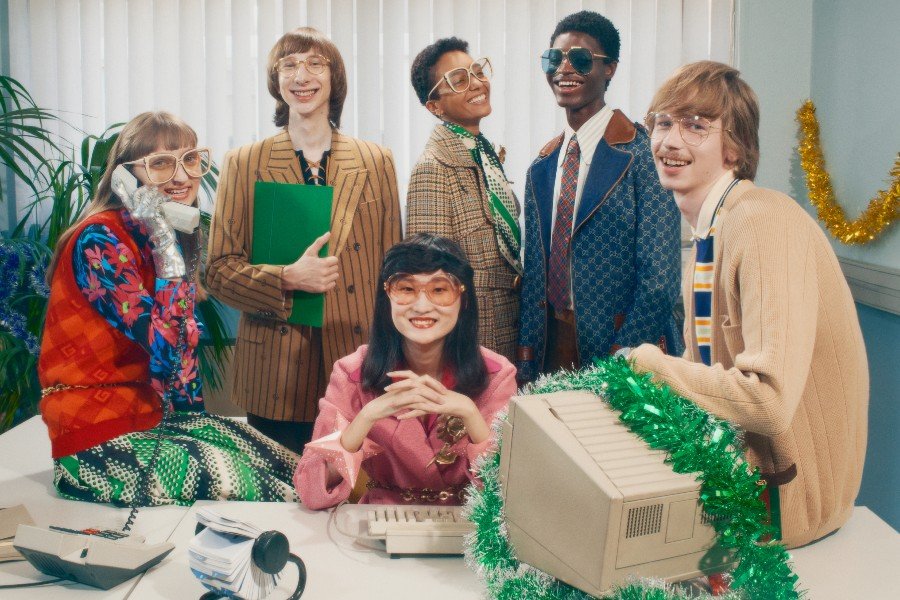
Gucci Gift Giving Collection 2020 by © Mark Peckmezian, courtesy of Gucci
"Architecture comes from the making of a room," Louis Kahn once said⁹, adding that "a room is not a room without natural light." The late American architect felt that design could only be codified to a certain point, emphasising the need for the organic and imprecise. When we focus on the allure of artificial decoration, we risk losing sight of the authentic worlds we're trying to adorn. The same can be said when we attempt to "optimise" our lives with AI.
"I only wish that the first really worthwhile discovery of science would be that it recognised that the unmeasureable is what they're really fighting to understand," Kahn once shared. "And that the measureable is only the servant of the unmeasureable; that everything that man makes must be fundamentally unmeasureable."
The fanatical application of tinsel can bury the beauty of a sun-kissed room or an innocent fir tree. Similarly, overzealous adoptions of AI can interfere with our connections to the real landscapes we travel together. Treating AI systems like tinsel seems mad, but in realms where AI hype hazes the human impact of technology, it pays to apply programs with the same care we do when adorning rooms like the ones Kahn described.
"We are not so pretentious as to propose an ideal dwelling," the late French architect Renée Gailhoustet once said¹⁰. "We merely wish to create possibilities for choice." Whether you're decorating a space or engaging AI this festive season, scrutinise the materials available to you before you begin. Your choices won't always be perfect, but intention is key. Software may not sparkle, but we all hold the power to give our tech practices a sustainable shine.
-
Arts & Crafts by Judith Miller, Jill Bace and Graham Rae via BIBLIO
'Is AI dulling our minds?' by Liz Mineo via The Harvard Gazette
'Origin and history of tinsel' via Online Etymology Dictionary by Douglas Harper
'Nvidia Founders’ Edition GPU Raw Materials Acquisition and Manufacture' by Ryan Koski via Design Life-Cycle
'Why you should ditch tinsel, and what to decorate with instead' by Eleanor Kittle via Vogue Scandinavia
Microsoft’s Kate Crawford: ‘AI is neither artificial nor intelligent’ by Zoe Corbyn via The Guardian
The Architect and the Academy: Essays on Research and Environment by Dean Hawkes via Routledge
'Back gardens in the sky! The riotous, post-apocalyptic buildings of ‘eco-brutalist’ Renée Gailhoustet' by Catherine Slessor via Guardian Australia
-
Images from Gucci Gift Giving campaign 2020 via i-D
Photographer | Mark Peckmezian
Creative Director | Alessandro Michele
Art Director | Christopher Simmonds
Quisque iaculis facilisis lacinia. Mauris euismod pellentesque tellus sit amet mollis.